

Recently, Peng Jun, Director of the Collaborative Intelligent Education Innovation Center at the Global Institute for AI Innovation, Associate Editor of the Global AI Education Journal, and AI education expert, delivered specialized training sessions on "AI Empowering Education Management and Teaching Innovation" for the management of Yunnan Hanwen Education Group and the faculty of the School of Education at Yunnan College of Business and Technology under the group. The two sessions focused respectively on building AI capabilities in education organizations and AI teaching innovation among university faculty, forming front-line practical samples spanning from "organizational collaboration" to "classroom transformation".
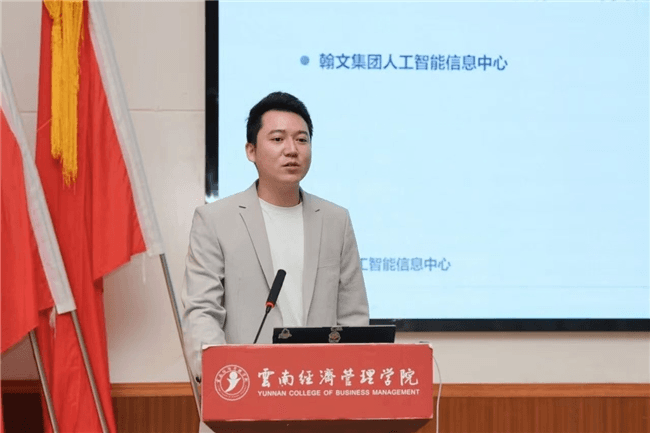
The Global Institute for AI Innovation (GIAI) has long focused on AI education, frontier research, industry integration, and innovation and entrepreneurship incubation, emphasizing the combination of theory and practice and driving the value of AI to be realized in real-world scenarios. This series of training sessions is an important manifestation of the GIAI Collaborative Intelligent Education Innovation Center carrying out application-oriented exploration on the education front line.
In the training for the education group, Peng Jun took "AI Empowering Education Management and Teaching Innovation" as the theme, focusing on the practical needs of managers, administrative staff, and educators in their daily work. The training did not stop at simply introducing AI tools, but explained how to truly embed AI into work processes around high-frequency scenarios such as meeting minutes, leadership reports, recruitment screening, enrollment promotion, employment services, and knowledge base construction.
Peng Jun noted that the truly important capability in the AI era is not knowing how to open a certain tool, but being able to define goals, break down tasks, choose tools, set standards, and review results. Using the accessible analogy of "humans are the boss, AI is the employee", he helped participants understand the essence of human-machine collaboration: humans are responsible for direction, judgment, accountability, and value, while AI handles draft generation, information organization, format conversion, proposal expansion, and preliminary analysis.
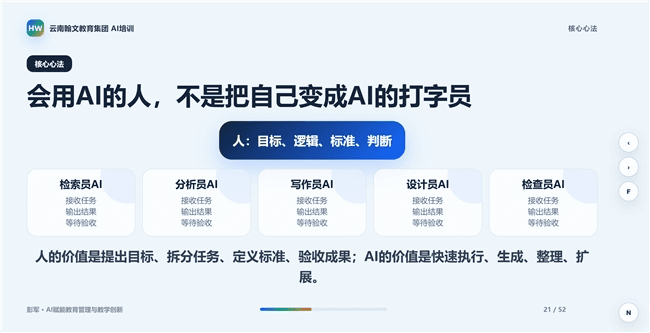
In the training for the faculty of the School of Education, Peng Jun further extended AI applications to classroom teaching, learning feedback, and teachers' professional development. He argued that the more powerful AI becomes, the more teachers need to return to education's "native questions": what kind of person should students grow into, what kind of learning process should teachers design, and at which stages should AI unleash human creativity.
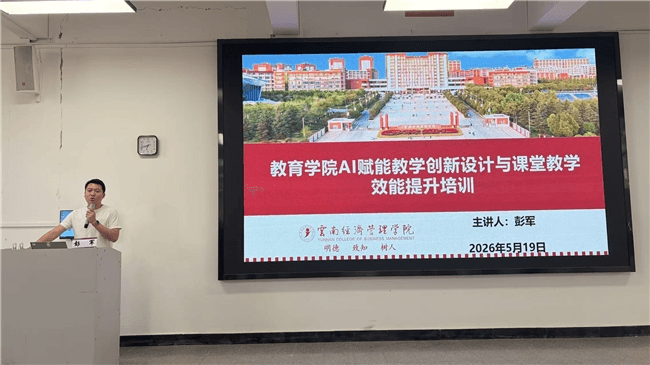
Around teaching scenarios such as college English, translation training, writing feedback, and student self-directed learning, Peng Jun demonstrated how AI can become a student's "personal diagnostician", "thinking scaffold", and "learning feedback partner". He emphasized that AI should not merely give students answers, but should help them identify problems, restructure their thinking, improve their expression, and ultimately develop self-driven learning ability.
Both training sessions were anchored in the "OPE - One Person Education" concept proposed by Peng Jun. The concept emphasizes that in the AI era, an individual, with the help of appropriate AI tools, can accomplish course design, resource development, teaching feedback, project research, and organizational collaboration that previously required teamwork. For the education group, this means individual experience can be accumulated into organizational assets; for university faculty, it means teachers can use AI to amplify their professional capabilities and restructure teaching processes.
In teaching prompts, Peng Jun did not reduce them to mere templates, but explained them as "a way to manage AI work using natural language". Drawing on frameworks such as CRISPE, TASK, and CLEAR, he emphasized that a good prompt needs to clearly articulate the goal, background, materials, standards, format, and iteration requirements. Its core is not about "memorizing formulas", but about making one's thinking process clear enough that AI can collaborate according to the real task.
Notably, both training sessions used interactive HTML webpages as the presentation medium. Compared with traditional PPT, such web courseware features page navigation, interactive buttons, card highlighting, prompt copying, and case displays, not only enhancing the on-site visual effect but also demonstrating AI's capability in assisting content production and instructional design. Peng Jun stated that training outcomes in the AI era should not merely be "finishing a lecture", but should be accumulated into reusable, presentable, and iterable digital teaching assets.
At the organizational level, the training emphasized shifting from "one-time use of AI" to "long-term AI capability building". Peng Jun suggested that departments gradually establish libraries for institutional rules, training, projects, enrollment promotion, employment services, and teaching quality, so that experience scattered across personal computers, WeChat groups, and meeting minutes can be transformed into searchable, queryable, and reusable organizational knowledge assets.
At the teaching level, the training emphasized that teachers should integrate AI throughout the entire process of lesson preparation, instruction, tutoring, evaluation, and reflection, while firmly upholding educational judgment, academic norms, and value guidance. AI can improve efficiency but cannot replace a teacher's understanding of student growth; AI can generate content but cannot replace a teacher's grasp of teaching objectives and the direction of cultivating people.
Peng Jun stated that implementing AI education cannot stop at spreading concepts, nor can it merely chase trending tools. Truly valuable AI education innovation must enter real work, real classrooms, and real organizational processes, validating methods through front-line problems, forming cases through continuous practice, and building systems through the accumulation of cases.
This series of training sessions demonstrated the practical direction of the GIAI Collaborative Intelligent Education Innovation Center in implementing AI education: on the one hand, driving education organizations to enhance their AI collaboration and knowledge-accumulation capabilities, and on the other, driving university faculty to reconstruct teaching design and student-cultivation models for the AI era. Going forward, the Center will continue its exploration around enhancing teachers' AI literacy, building AI workflows for education groups, developing AI-native courses, cultivating students' AI learning abilities, and incubating education innovation cases, helping AI truly serve the high-quality development of education.