

Recently, Peng Jun, Director of the Collaborative Intelligent Education Innovation Center at the Global Institute for AI Innovation (GIAI), Associate Editor of the Global AI Education Journal, and AI education expert, delivered a specialized AI-empowered teaching innovation training for the faculty of the School of Education at Yunnan College of Business and Technology under Yunnan Hanwen Education Group. Centered on "AI-native teaching capability", "prompt engineering", "the reconstruction of the teacher's role", and "student self-driven learning", the training explored how university teachers can reconstruct teaching design, learning feedback, and talent-cultivation models in the context of generative AI.
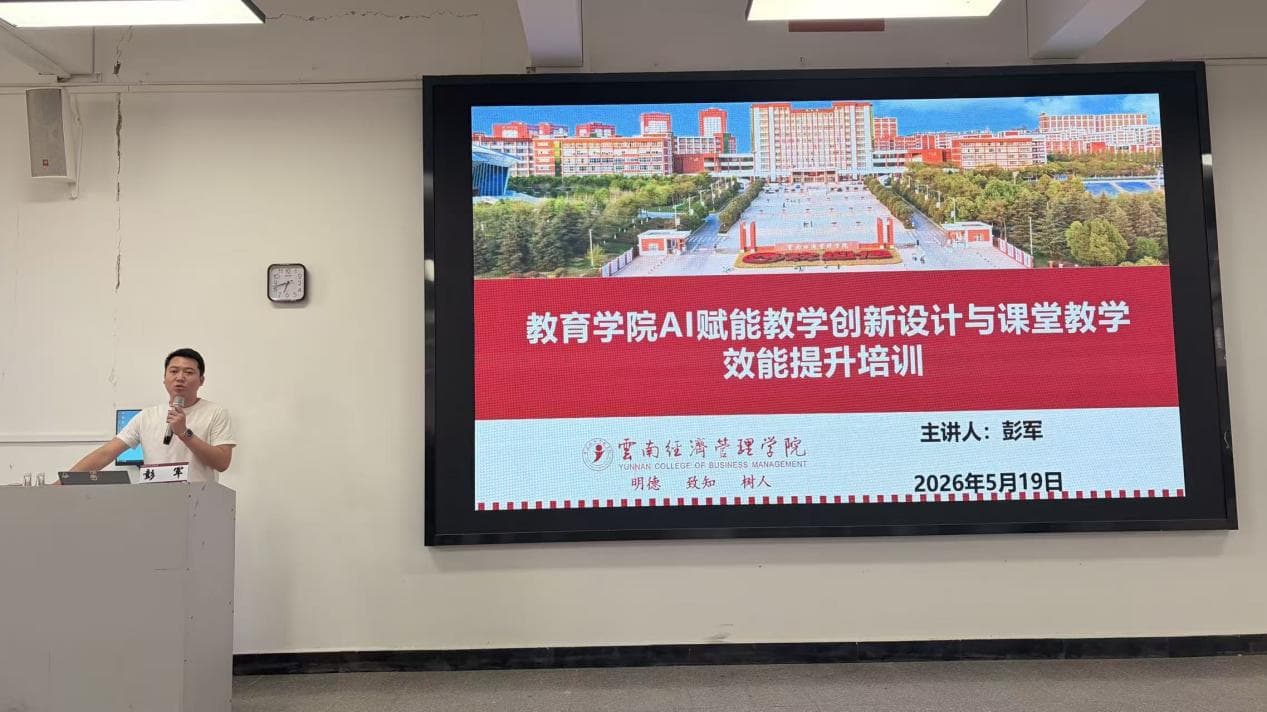
At present, AI is profoundly affecting content production, classroom organization, learning assessment, and student development in higher education. With the promotion of AI education and innovation as a key direction, GIAI focuses on theoretical research, educational practice, and industry integration. This training is a practical case of the GIAI Collaborative Intelligent Education Innovation Center bringing AI education concepts to the front line of university teaching.
During the training, Peng Jun argued that the more powerful AI becomes, the more teachers need to return to education's "native questions": what kind of person should students grow into, what kind of learning process should teachers create, and at which stages should AI unleash the potential of teachers and students. He emphasized that AI is not about helping students get answers faster, but about helping them more clearly raise questions, diagnose problems, and restructure their thinking, ultimately developing the ability to learn independently.
Addressing the classroom-implementation issues teachers care about most, Peng Jun drew on cases such as college English teaching, translation training, writing training, and learning feedback to propose that AI can become a student's "personal diagnostician", "thinking scaffold", and "learning feedback partner". In translation teaching scenarios, AI does not merely provide a translation, but helps students identify deeper issues such as Chinglish expressions, logical breaks, inappropriate register, and the handling of long, difficult sentences, shifting learning from "looking at the answer" to "looking at the reasoning".
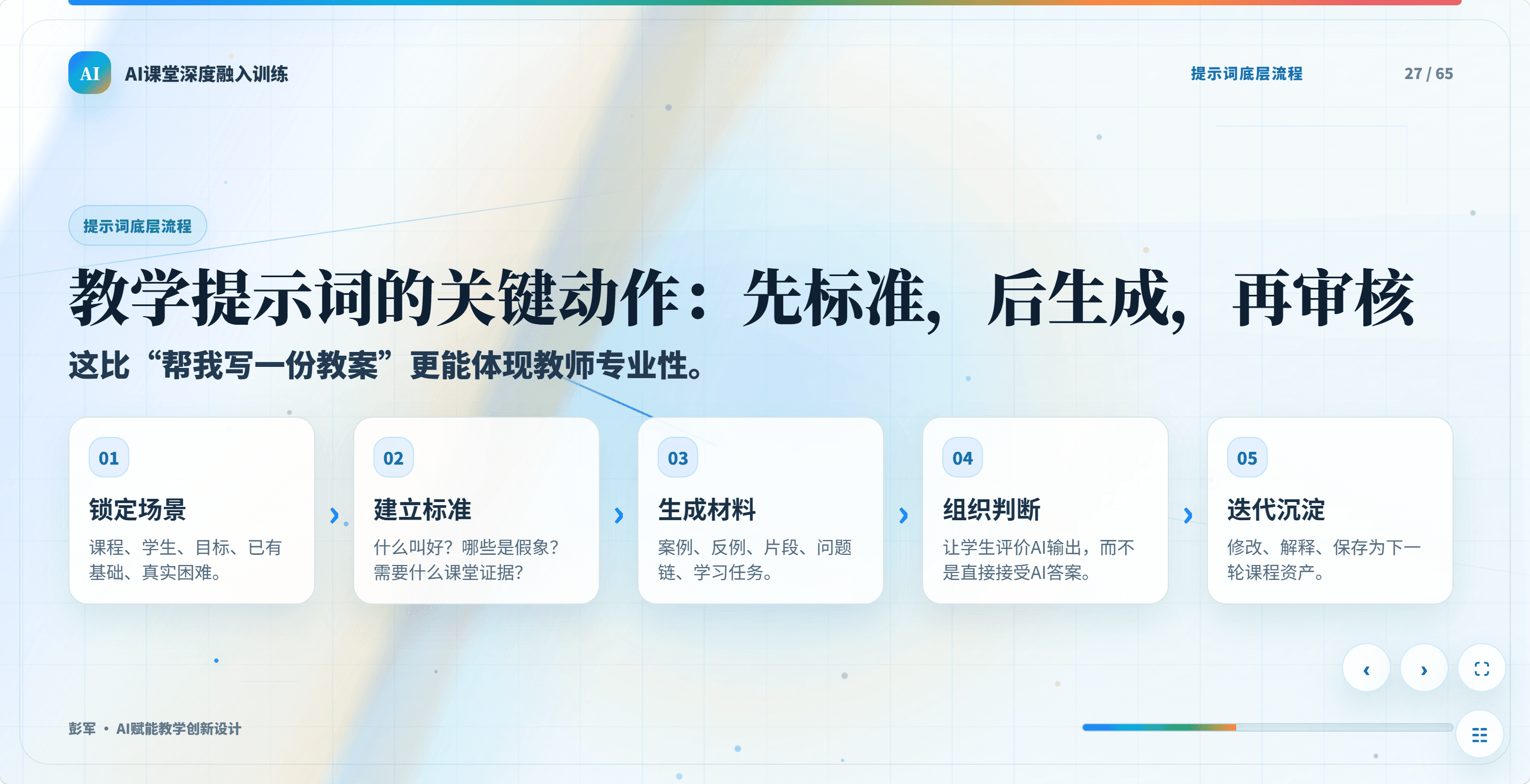
In the prompt-engineering section, Peng Jun focused on the CLEAR framework, Context, Limitation, Example, Attitude, and Requirement. The framework emphasizes that when teachers and students use AI, they should clarify the role and scenario, task boundaries, reference examples, the intended attitude, and output requirements. Peng Jun noted that a prompt is not a "magic incantation", but a clear expression of one's thinking process that enables AI to collaborate in line with educational goals.
The training also paid special attention to the changing role of teachers in the AI era. Peng Jun believes that teachers should not regard AI as a threat, but should transform it into an auxiliary force for course design, learning diagnosis, resource generation, and process evaluation. The core value of teachers will increasingly be reflected in goal setting, task design, value guidance, process supervision, and quality judgment. The more content AI can generate, the more teachers need to hold fast to educational judgment, academic norms, and the direction of values.
Unlike general tool-introduction training, this training closely integrated AI capability building with teachers' teaching innovation, curriculum reform, and student development. Peng Jun used an interactive HTML presentation webpage to demonstrate the teaching logic, designing the training itself as an "AI co-creation outcome", both a teaching tool and a visual example of AI-empowered teaching innovation.
Peng Jun stated that the focus of future AI education training should not merely be "teaching teachers to use a few tools", but helping teachers establish a transferable methodology: how to design learning tasks involving AI, how to guide students in AI-assisted reflection, how to use AI to generate personalized feedback, and how to prevent students from becoming dependent on AI and losing their ability to think. True AI education innovation is making AI a new type of infrastructure that promotes the growth of students' thinking and teachers' professional development.
This training further reflected the practical direction of the GIAI Collaborative Intelligent Education Innovation Center: rooted in the education field, connecting the AI frontier with classroom reform, and driving AI technology from concepts, tools, and demonstrations into real teaching processes. Going forward, the Center will continue its exploration around enhancing teachers' AI literacy, building AI-native courses, cultivating students' AI learning abilities, and incubating education innovation cases.